Is AI Writing Considered Plagiarism? A Clear Student Guide

Updated: January 08, 2026 · 10 min read
Summary: AI writing is considered plagiarism when you present AI-generated text as your own original work without disclosure. Universities define this as “unauthorized assistance,” “misrepresentation of authorship,” or “unattributed source use,” even if the text is unique and passes plagiarism checks. AI itself isn’t illegal — but undisclosed AI can violate academic integrity rules in most institutions.
AI writing tools exploded across campuses, giving students faster ways to brainstorm, structure essays, and understand complex topics. But here’s the problem: universities didn’t adapt instantly — and now AI misuse ranks among the top academic integrity violations worldwide.
Most students aren’t trying to cheat. They’re overwhelmed, confused about AI policies, and worried about false AI-detection flags. This guide breaks it all down: when AI writing becomes plagiarism, when it’s allowed, how detection works, and how to use AI safely without accidentally violating university rules.
Key Takeaways
- AI writing = plagiarism when submitted as your own work without disclosure.
- AI tools are allowed for planning, brainstorming, outlining, and research guidance in many courses.
- AI text is often “original” but still counted as unauthorized assistance.
- AI detectors are unreliable – false positives happen often.
- You can use AI safely if you keep authorship, critical thinking, and citation intact.
Is AI Writing Plagiarism Even If the Text Is Original?
Yes – because plagiarism isn’t only about copying. It’s about authorship. AI tools generate text based on patterns, not your own thinking or writing identity. When you submit that text as your original work, you misrepresent authorship — which equals plagiarism under most academic integrity codes.
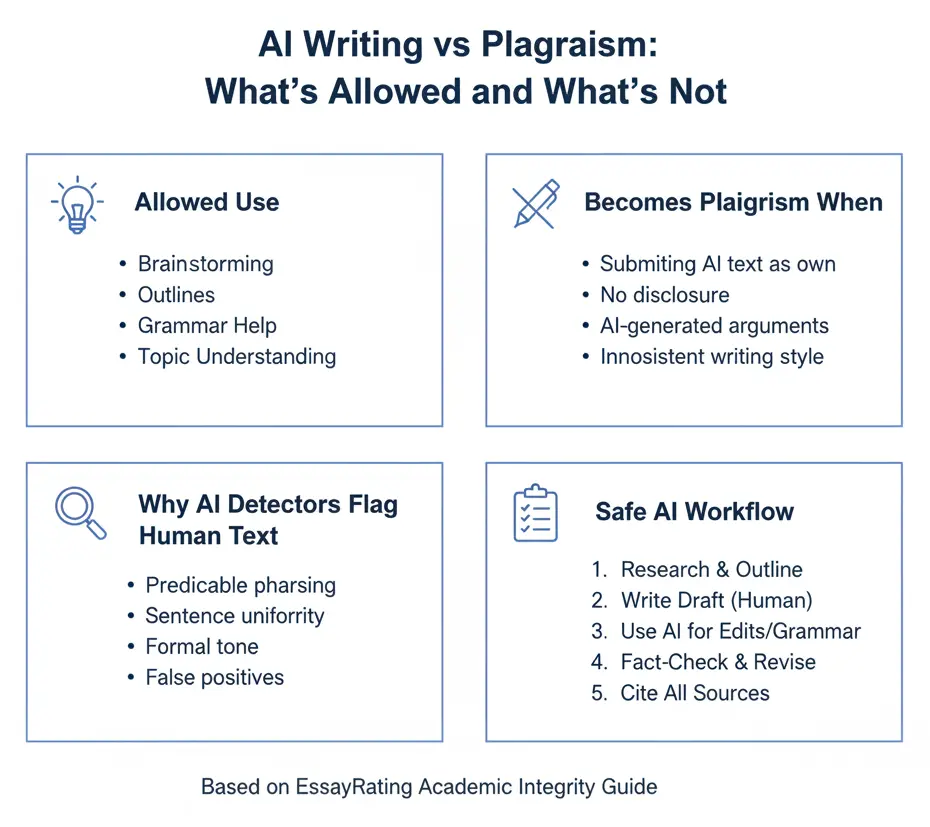
Universities categorize AI misuse under:
- Misrepresentation of authorship
- Unauthorized assistance
- Improper use of AI tools
- Failure to acknowledge sources
Even if Turnitin shows “0% similarity,” the work can still violate academic integrity because it’s not 100% authored by you.
What Universities Actually Say About AI Writing
Policies vary, but three patterns appear across schools in the U.S., Canada, the U.K., and Europe:
| Policy Type | What It Means | Is AI Writing Allowed? |
|---|---|---|
| Strict / No AI | AI writing is treated like unapproved outside help. | No, unless explicitly permitted. |
| Conditional Use | AI allowed only for planning, grammar, or clarity. | Yes, with disclosure. |
| Open Use | AI can be used as a tool, but ideas must be original. | Yes, responsibly. |
When AI Writing Becomes Plagiarism
AI writing crosses the plagiarism line when any of these occur:
- You submit AI text verbatim.
- You use AI to generate arguments and pass them off as your own.
- You don’t disclose AI use where required.
- You rely on AI for research interpretations or evidence.
- You produce work inconsistent with your writing history.
AI writing becomes unethical when it replaces your thinking and authorship. But using AI to brainstorm, outline, or clarify ideas is closer to using Grammarly, tutoring, or note-taking tools – acceptable in many courses.
False AI Detection Is a Real Problem
AI detectors (like GPTZero or Turnitin’s AI indicator) aren’t perfect. They rely on:
- linguistic signatures,
- semantic density,
- predictable phrasing,
- sentence uniformity.
Even human-written text can trigger AI flags – especially if the writing is formal, structured, or uses common academic constructions.
The irony?
A fully original, human-written paper can be flagged as AI, while AI-modified text may pass with a low percentage.
AI Writing vs Plagiarism: Key Differences
| AI Writing | Traditional Plagiarism |
|---|---|
| Generates new text using learned patterns | Copies existing sources without attribution |
| May violate authorship rules | Violates originality & citation rules |
| Hard to detect reliably | Easy to detect with similarity tools |
| Not plagiarism by default | Plagiarism by definition |
How to Use AI Without Violating Academic Integrity
You can use AI safely — if you follow a structured, ethical workflow:
- Start with your own ideas.
- Use AI for outlines or examples, not full paragraphs.
- Rewrite content in your own voice.
- Add personal reasoning and course materials.
- Cite AI use if the instructor requires disclosure.
The goal isn’t to avoid AI — it’s to avoid misrepresenting AI content as your own work.
Frequently Asked Questions
No - but submitting it as your own work without disclosure can still violate academic integrity rule
Turnitin flags probabilities, not certainties. False positives are common.
Yes. Brainstorming, planning, and outlining are allowed in many courses.
Only if you transform the ideas, structure, and reasoning into your own original work.
No. Some restrict it, others allow it with disclosure, and many permit AI for specific tasks.
Use it as a support tool — not as a replacement for your thinking or writing.
About the Team

Richard Wilson • Founder & Lead Reviewer at EssayRating. NYU Ph.D. who places real orders to audit quality, refunds, and AI/plagiarism risks - and leads our editorial standards.
Mary Rose • Creative Writer & Reviewer. UC San Diego journalism background; investigates refund terms, writer policies, and support transcripts to keep reviews clear and honest.
Julie Morgan • Student Reviewer & Experience Tester. University of North Texas; tests services under tight deadlines from mobile, documents support, and validates originality/AI.
Related Articles
Essay Services You May Like