Can Professors Tell If You Used a Writing Service?

Updated: March 2026 · 11 min read
Summary: Yes — professors can often tell when a student used a writing service, but not in the way most people think. They don’t “detect” it directly. Instead, they compare your writing patterns, class performance, argument style, and assignment history. Services that produce overly polished, generic, or mismatched writing raise red flags fast. But ethical tutoring-style help is generally safe, common, and aligns with academic integrity when used correctly
One of the biggest fears students have is: “If I get help, will my professor know?” Universities don’t use magical tools that instantly expose purchased essays. What they rely on instead is behavioral analysis, writing-style comparison, AI-assisted checks, and professional intuition built over years of reading student work.
This guide breaks down exactly what professors look for, what gets flagged, what’s considered normal, and how students use academic support responsibly — without crossing the line or triggering suspicion.
Key Takeaways
- Professors detect inconsistencies — not “writing services.” They compare your past work vs. the new submission.
- Sudden jumps in vocabulary, structure, or argumentation are the #1 red flag.
- AI-mix writing, over-polished style, and generic academic phrasing also catch attention.
- Ethical academic help (editing, outlining, feedback) is safe and widely used.
- Ghostwritten or AI-generated papers carry the highest risk of being flagged.
Can Professors Actually Detect Outsourced Writing?
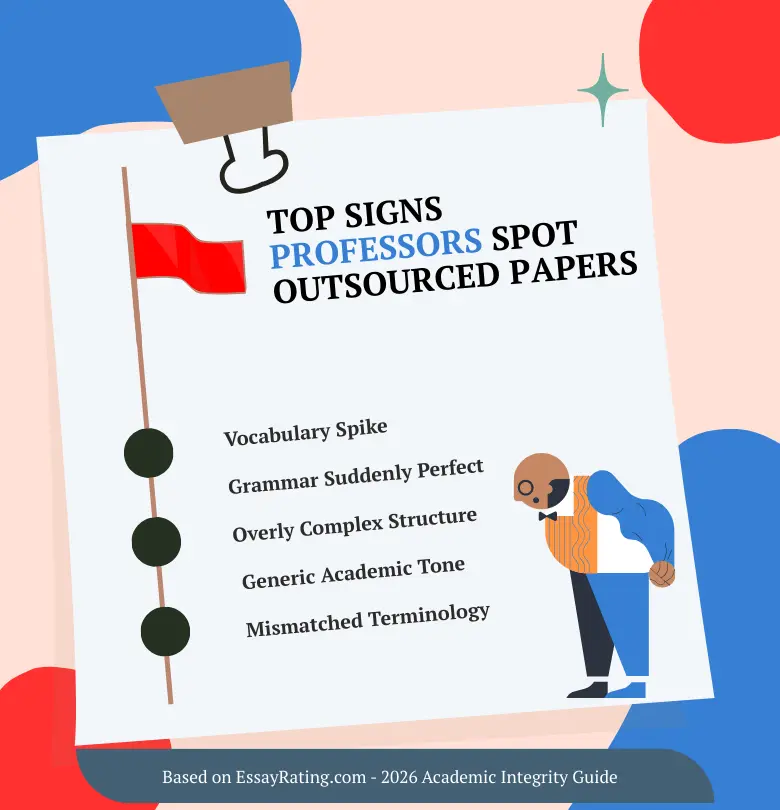
In most cases, professors can’t prove you used a writing service — but they can spot inconsistencies. A professor doesn’t need Turnitin for that. Years of reading your work gives them a mental profile of how you think, argue, and write.
When the next assignment suddenly looks like it was written by a PhD-level researcher, they instantly notice a break in your writing identity.
They don’t detect outsourcing. They detect mismatch.
Typical signs professors look for:
- Vocabulary significantly above your usual level
- Sudden change in grammar accuracy
- More complex sentence structures than before
- Different tone or “voice”
- Incorrect use of field-specific terminology (common in cheap ghostwriting)
- Examples or citations that don’t align with the course
- Writing that feels “generic” or “AI-like”
If three or more of these patterns appear together, the paper becomes suspicious.
How Professors Recognize Ghostwritten or AI-Assisted Papers
Here’s exactly what instructors analyze — even without tools.
1. Writing Style Consistency
Every student has a unique “style fingerprint.” It includes rhythm, sentence length, vocabulary range, and preferred transitions. If your previous work was simple and your new paper suddenly reads like a graduate thesis, the mismatch stands out immediately.
2. Authorship Questions (“Explain your paper” tests)
Some instructors now ask:
“Walk me through how you developed your argument.”
If you can’t articulate your reasoning, sources, or structure, they assume you didn’t write it.
3. AI-Mix Writing Flags
Even if the paper passes plagiarism checks, instructors detect AI characteristics:
- Overly symmetrical paragraphs
- Predictable transitions (“Additionally…”, “Furthermore…”, “In conclusion…”)
- Too formal or too generic
- Lack of real-world nuance or course-specific references
4. Topic Relevance and Course Fit
Ghostwriters often get key details wrong – assignment purpose, course expectations, or required sources. Professors instantly notice “off-topic alignment.”
5. Metadata & Draft History
Some universities use LMS features (Canvas, Blackboard) to check:
- draft progression
- file creation timestamps
- editing history
If there is no progression at all – only a final uploaded file – it may trigger suspicion.
Red Flags That Make Your Paper Look Outsourced
| Red Flag | Why It’s Suspicious | What Professors Expect Instead |
|---|---|---|
| Overly advanced academic language | Doesn’t match your previous submissions | Incremental skill improvement, not radical jumps |
| Generic arguments | Looks like a template, lacks course context | References to class readings, lectures, or discussions |
| No draft history | Instant uploads with no versioning | Visible revision process or notes |
| Incorrect discipline-specific terminology | Common in low-cost ghostwriting | Accurate use of course-level vocabulary |
| AI-like structure | Predictable phrasing, symmetrical logic | Human variation in tone and complexity |
Ethical Alternatives Students Use Safely
Most students don’t want ghostwriting — they want clarity, confidence, and better structure. Ethical support includes:
- proofreading
- editing for clarity and flow
- feedback on your draft
- outline creation
- source suggestions
- citation formatting
These services align with academic integrity because you remain the author.
How to Use Academic Help Without Raising Suspicion
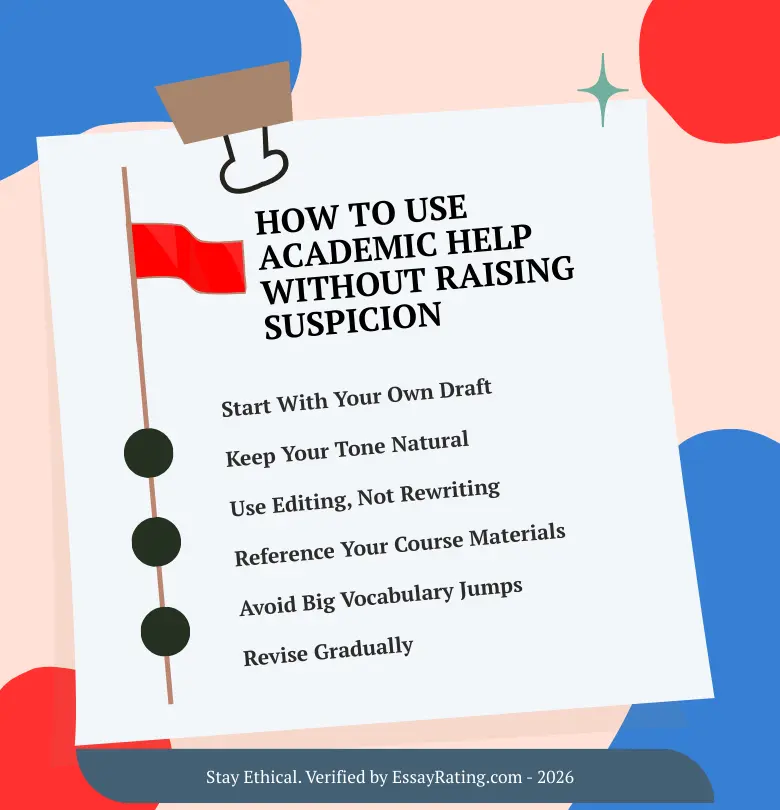
There are safe, student-friendly ways to get support:
- Start with your own draft – even if rough
- Use editing, not replacement
- Keep your voice (students naturally write simpler)
- Add course materials (professors love relevance)
- Use your university’s references or readings
- Don’t adopt unnatural vocabulary
This keeps your work authentic, original, and consistent with your writing identity.
Frequently Asked Questions
They can suspect it — but proving it is hard unless the mismatch is extreme. Most cases rely on writing-style comparison
Not directly. They catch AI patterns, not ghostwriting. Human-written outsourced papers are flagged by inconsistency, not AI tools.
Editing, proofreading, outlining, and feedback — all academically acceptable
Only if you submit work you didn’t author. Ethical support is allowed.
Huge jumps in skill level, tone, or vocabulary immediately stand out
Use your own voice, revise drafts gradually, and integrate course references
About the Team

Richard Wilson • Founder & Lead Reviewer at EssayRating. NYU Ph.D. who places real orders to audit quality, refunds, and AI/plagiarism risks - and leads our editorial standards.
Mary Rose • Creative Writer & Reviewer. UC San Diego journalism background; investigates refund terms, writer policies, and support transcripts to keep reviews clear and honest.
Julie Morgan • Student Reviewer & Experience Tester. University of North Texas; tests services under tight deadlines from mobile, documents support, and validates originality/AI.
Related Articles
Essay Services You May Like